Tech-Jam 2026: Global CTF Infrastructure
2026Scaled international CTF architecture serving 439K+ requests across Morocco and Pakistan with real-time observability.
The Problem
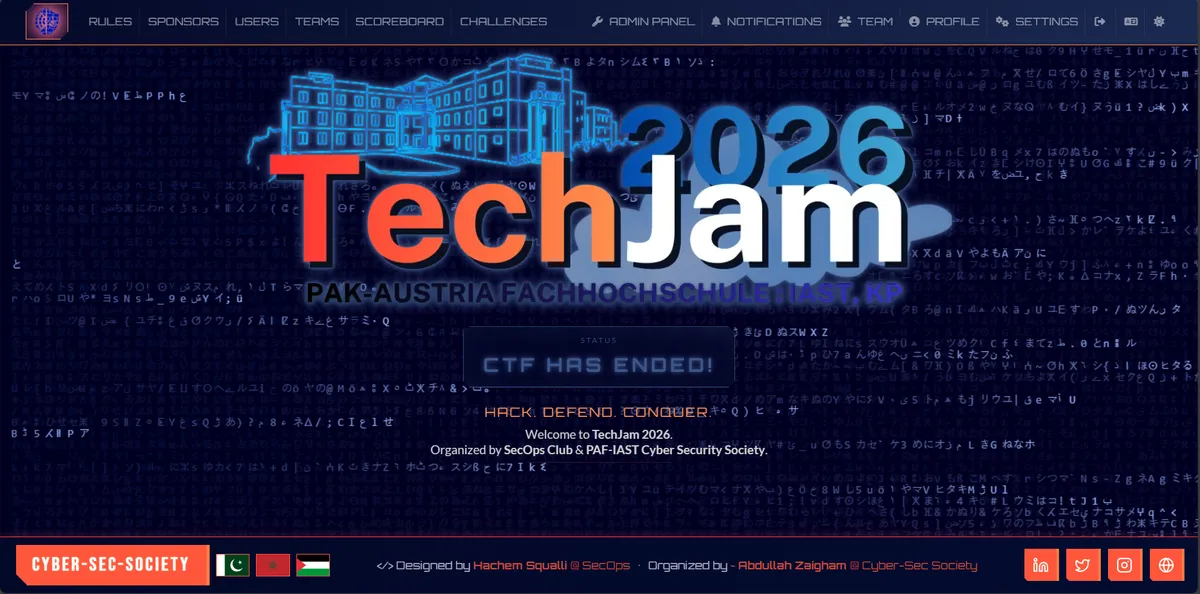
Following the success of CyberTech Day V3.0, the SecOps ENSAF club was trusted to act as the technical partner for Tech-Jam 2026, the first-ever international Capture The Flag (CTF) competition hosted by the Cybersec Society at PAF-IAST (Pak-Austria Fachhochschule) in Pakistan.
Taking our infrastructure global introduced a new magnitude of complexity. We were no longer just defending against local engineering students; we had to support over 100 highly skilled international hackers.
- Traffic Spikes: We anticipated a massive jump in volume, requiring the architecture to handle nearly half a million requests across 48 hours.
- Global Latency: Routing traffic efficiently between Morocco and Pakistan was critical to ensure a fair competition environment without frustrating lag.
- Blind Spots: During previous events, we lacked deep visibility into how the infrastructure was being attacked. We needed a way to monitor the competition health and filter bot traffic in real-time.
The Solution
I served as the Technical Lead, upgrading our core Docker-based foundation into a highly optimized, internationally scalable deployment with advanced telemetry.
Here is how the infrastructure evolved for the global stage:
1. International Performance Optimization
To combat cross-continental latency, I implemented an aggressive caching strategy using Cloudflare Edge Caching and multi-region CDN routing (Cloudflare Argo).
- By pushing static assets and the GSAP-animated frontend to the edge, we achieved a ~60% cache hit rate.
- This meant over 260,000 requests were served directly from local edge nodes in Pakistan and Morocco without ever touching our origin server, resulting in sub-2-second global load times.
2. Real-Time Observability Stack
Scaling up meant we could no longer rely on standard Docker logs. I built a comprehensive “Live Traffic Intelligence” ecosystem.
- Deployed Grafana, Loki, and Promtail to aggregate logs from Nginx, the CTFd backend, and all 15+ isolated challenge containers.
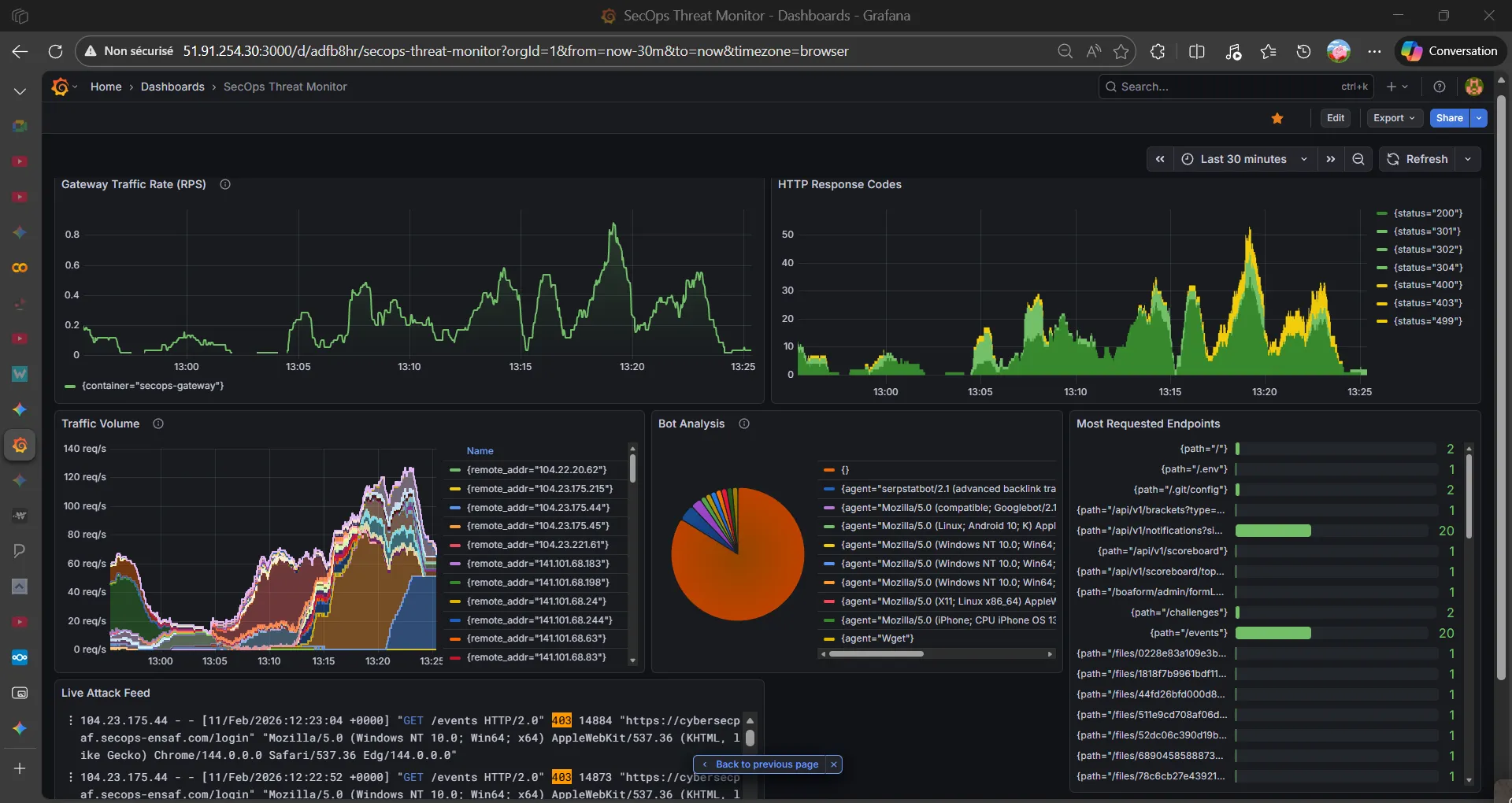
- Created custom Grafana dashboards to visualize request spikes, track HTTP 4xx/5xx error rates, and monitor container resource consumption (CPU/Memory limits). This allowed the operations team to instantly spot automated brute-force scripts and dynamically apply IP bans or rate limits.
3. Advanced Nginx Gateway Configuration
I refined our Layer 7 Reverse Proxy configuration to handle complex challenge routing securely.
- As seen in the architectural code (
nginx-prod.conf), I engineered strict subdomain routing (internal.secops,upload.secops,vault.secops) to isolate Web and Reverse Engineering challenges. - Enforced robust security headers (
X-Frame-Options,X-XSS-Protection) and appliedlimit_req_zone(30 requests/minute) at the proxy level to prevent denial-of-service attempts on the vulnerable containers.
4. Challenge Engineering & Offensive Security
Transitioning from purely defensive DevOps, I also authored over 20 unique cybersecurity challenges (Web, Forensics, Reverse Engineering). Designing the very payloads and vulnerabilities used to stress-test the system proved invaluable; understanding offensive vectors directly informed how I architected the network isolation and resource quotas.
The Results & International Collaboration
The collaboration between Morocco and Pakistan was a massive technical success, proving that our infrastructure was not just functional, but truly resilient under international pressure.
- Massive Scale: Successfully processed 439,000+ requests and served 7 GB of bandwidth to international participants.
- Flawless Execution: Maintained 100% uptime throughout the entire 48-hour competition.
- Architectural Efficiency: The 60% CDN cache hit rate drastically reduced server load, allowing the origin server to comfortably handle the complex backend processing and database transactions.
🤝 Morocco 🤝 Pakistan Partnership
Massive thanks to the entire Cybersec Society team from PAF-IAST for trusting SecOps ENSAF as their technical partner. Special shoutout to their leadership team—Jarar Abdullah (President), Raja Siraj (General Secretary), Abdullah Zaigham, and Seerat E Marryum—for the seamless coordination and collaboration.
And a huge thank you to Mariam Daoudi, President of SecOps ENSAF, for empowering me to represent our club internationally.
Building the Tech-Jam 2026 infrastructure was a masterclass in DevSecOps—bridging offensive challenge creation with the defensive architectural resilience required to host them globally.